On March 19, 2020 Governor Greg Abbott issued an executive order closing bars, restaurants and schools in Texas, the first response to documented community spread of the Covid-19 virus in Texas. On March 22, 2020, Harris, Dallas, Tarrant, Bexar, Collin and Travis Counties issued stay at home orders, effectively shutting down economic activity in the largest cities. On that date there were 92 new Covid-19 cases in the state of Texas. On August 11, 2021 there were 21,854 new cases. And everything is open.
In March of last year, the shutdown was intended to stop community spread of the novel coronavirus and avoid a full-scale pandemic in the United States. At first, the shutdown strategy appeared to work, but because it was limited, it failed. The subsequent failure of government at all levels to manage the pandemic has been stunning. I have written about what should be done the next time (and there will be a next time), which is also a description of what should have been, and for the most part was not, done this time. Basically, the response to the pandemic should have been managed by local health authorities, using public health measures, and not by the Governor at the state level. The emergency management statute in the Texas Government Code was not intended for response to public health emergencies, and the Governor has used his powers under the statute to obstruct local public health officials rather than to support them.
The recession caused by the economic shutdown in early 2020 was technically only two months, but economic growth has only been possible during the past year because it is based on the baseline trough of the recession in April 2020. Texas political leadership (again with the buck stopping at the Governor) has been more interested in protecting the economy than in protecting the public health. In addition, conservative leaders at all levels of government have opposed rational public health recommendations for political purposes. Rallying populations with the call for personal liberty and responsibility, conservative leaders have opposed vaccination, restrictions on gatherings (like church), travel restrictions, and face mask mandates. The result has been a prolonged pandemic, with multiple surges in cases, hospitalizations and deaths. The sad fact is that most of the infections, hospitalizations and deaths for the past couple of months were preventable. And yet we are nowhere near the end.
So, what do we do now? Incredibly, we currently have only voluntary guidelines and no restrictions. Restaurants and bars are fully open, public gatherings are not prohibited, travel is not restricted, schools and universities are open, and face mask mandates are sporadic. The almost vertical rise in new cases is clear evidence that voluntary guidelines are not working and public health restrictions are necessary.
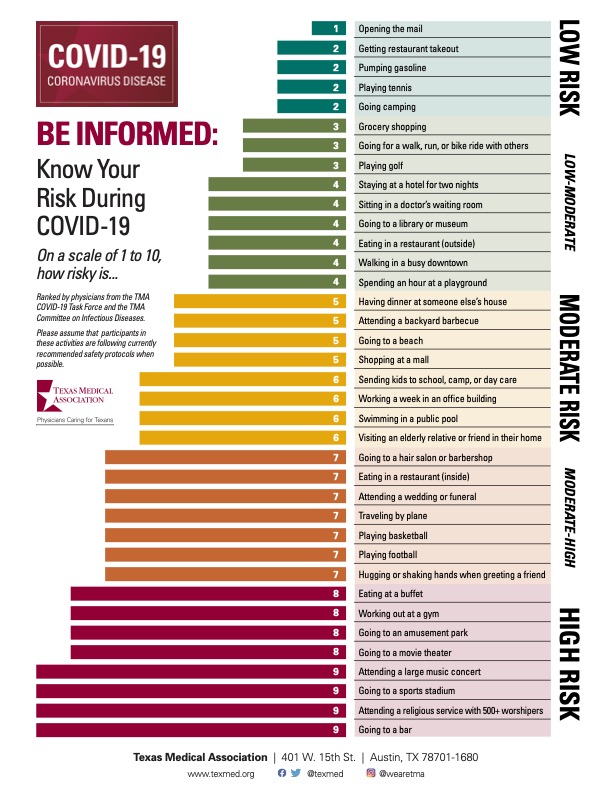
In July of 2020, the Texas Medical Association COVID-19 Task Force and Committee on Infectious Diseases produced a chart that ranks activities and the associated risk for Covid-19 infection. This chart defines 5 levels of risk from lowest (opening the mail) to highest (going to a bar). The chart is pictured at the top of this post. With the objective of minimizing community transmission of the Covid-19 virus, and using our primary tool – vaccination, it is fairly simple to describe a public health plan of action. Here is what I recommend for any county where community transmission is considered substantial or high (as defined by the CDC).
Activities that are considered high risk (8 in the chart) should be prohibited until community transmission falls to moderate levels (as defined by the CDC). High risk activities include:
- Eating at a buffet
- Working out in a gym
- Going to an amusement park
- Going to a movie theater
- Attending a music concert
- Going to a sports stadium
- Attending a religious service with 500+ worshipers
- Going to a bar
When community transmission falls to a moderate level, vaccinated persons only should be allowed to participate in high-risk activities. Non-vaccinated persons should be prohibited from these activities until community transmission is at a low level. Should transmission levels rise again, restrictions should be reinstituted immediately.
While community transmission is at a substantial or high level in a community, activities that are considered moderate-risk (5-7) should be restricted to vaccinated persons only. This list includes (see full list in chart which includes personal interactions):
- Playing contact sports
- Attending weddings and funerals
- Attending school, camp and daycare
- Eating inside a restaurant
- Going to a salon or barber shop
- Working in an office building
- Shopping in a mall
- Traveling by plane
As Covid-19 infection has clearly been spread by domestic and international travel, I believe that all travel by mass transit should be included on this list as moderate-risk. That means only fully vaccinated individuals should travel by bus, train or commercial airline until community transmission is low. I have previously written that it is not safe for children to be in school with the current high levels of community transmission. This is because children under the age of 12 can’t be vaccinated yet, and we do not have full vaccination for eligible students, teachers and staff. For daycare, full vaccination of caregivers may make it safe for young unvaccinated children to attend daycare. When community transmission is at a low level, non-vaccinated individuals can participate in moderate-risk activities.
For low-risk activities (1-4), practical social distancing, good hygiene and face mask use indoors should allow both vaccinated and unvaccinated persons to continue these activities during substantial or high community transmission (see full list in chart):
- Getting restaurant takeout
- Exercising outdoors
- Grocery shopping
- Traveling independently and staying in a hotel
- Eating outdoors at a restaurant
Recommendations for testing following exposure or symptoms, isolation pending test results, and quarantine after positive tests should be continued as recommended for vaccinated and unvaccinated individuals. Contact tracing should also be pursued, particularly in school and workplace settings.
Vaccination is the primary tool that we have to end this pandemic. Those who prefer not to be vaccinated should face restrictions on activities until community transmission is low. This may provide an incentive for those who are vaccine-hesitant. Face mask use, while having limited benefit, is easy and safe and should be included in recommendations. Since we don’t know who has been vaccinated and who has not, face mask use indoors in public spaces should be universal while community transmission is substantial or high.
It is time for public health officials to stand up and protect the public. We can put this pandemic behind us if we adopt reasonable public health measures.
 Waterloo to Austin
Let the professionals work it out. But as you know, a populace without immunity will continue to be vulnerable.
LikeLike
Unfortunately, the professionals include our old colleague John Hellerstedt, who while he has not been consulted by the Texas Governor is “on the same page”. I think we all agree that the Governor has no plan for the people, only a plan to run for higher office.
I would also point out that this is not rocket science. A couple of family docs could figure this out.
LikeLike
Funny you ask. Had to fast this am for some labs.
LikeLike