Homelessness in Austin Part 4 – Substance addiction and rehabilitation

Photo by Piyapong Sayduang on Pexels.com

In 1993, I was the medical director for the first health plan to provide a managed care model for the Texas Medicaid population.  This program started in Travis County and included management of the limited mental health services covered by Medicaid through an HMO network model.  Within the first few months of the program, I was made aware of an out of network hospital in Center Point, Texas that was filing Medicaid claims for inpatient detoxification services.  At that time, Medicaid coverage for substance addiction was limited to inpatient detoxification only (rehabilitation services were not covered).   I had a general idea where Center Point was, but I could not understand how so many Medicaid patients from Travis County were ending up there for 30 days of detoxification.  My wife and I took a drive to Kerr County one Sunday afternoon and found the Starlite Village Hospital at the end of a private drive, off of a county road, and inside a cattle guard next to an emu ranch.  The hospital did have a sign out front with the words “24 Hour Emergency Room” under a big red arrow pointing to a side door.  

My purpose in recounting this story is not to make a point that inpatient acute detoxification services are not the same as inpatient rehabilitation services, which were not a benefit of the Texas Medicaid program until 2010.  My point is that the Starlite Village Hospital (which is now the Starlite Recovery Center) is located in the middle of nowhere for a reason.  It removes patients with substance addiction from an environment where they might have access to alcohol and drugs of abuse.   Controlling the environment is a key to success for inpatient and as well as outpatient rehabilitation programs.  That is why most patients who can afford it are referred to treatment centers several states away from where they live.  You will not be successful with substance abuse rehabilitation if a patient continues to live under a bridge in downtown Austin, or anywhere in downtown Austin for that matter.  Some sort of stable housing outside of downtown Austin is required.

In previous articles I have written that we will not solve the issue of chronic homelessness if we do not address the root causes of chronic homelessness.  Members of the Austin City Council often state that the causes of homelessness in Austin are lack of affordable housing, wage stagnation, economic segregation and poverty, and incarceration.  These are the causes of homelessness for the population experiencing temporary displacement.  The Council also quotes data from the Housing and Urban Development Point-in-Time surveys to quantify and qualify homelessness in Austin.  These surveys have been conducted in Austin by a homeless advocacy group, the Ending Community Homelessness Coalition (ECHO).  According to the 2020 report based on a 6-hour long survey effort, the total homeless count in Austin was 2506, 37% were sheltered, 61% were white and 38% were female.  The Point-In-Time surveys are done by municipalities to request federal funding from the Department of Housing and Urban Development.  They are incredibly inaccurate as a full accounting of the homeless, and over-survey sheltered populations vs. unsheltered populations.  

For example, an audit in 2019 by Front Steps (the organization operating the Austin Resource Center for the homeless) reported 9000 unique individuals received homeless services in Austin.  That is almost four times more than the homeless population estimated by the Point-in-Time count.  It is likely that most of the sheltered population was captured in the ECHO survey.  This means that the unsheltered population is much larger than they estimate.  The Point-in-Time count also provides no information about causes of homelessness, migration patterns, or even the need for specific services (like treatment for substance addiction).  It does not even attempt to identify or define the number of people who are chronically homeless.

There are actually very few scientific surveys of the chronically homeless population.  Most studies have surveyed primarily sheltered populations which are more likely to be families or female, younger, non-disabled, and importantly, temporarily displaced.  One of the best studies of the chronically homeless population was done in Manhattan in 2009.  I would argue that Austin is now a large metropolitan city and our homeless population is probably similar to that of Manhattan.  In that survey of chronically homeless individuals, 67% were chronically homeless and unsheltered, and that group was 90% male, 31% white, about 47 years of age, and had spent almost 10 years on the streets on average.  84% had a history of lifetime mental illness, lifetime substance abuse, or a serious medical issue, and 76% had been incarcerated.  In this group 67% had a history of lifetime substance abuse.  This is very different from the Austin ECHO survey. (see the full text publication of the Manhattan survey here: https://ps.psychiatryonline.org/doi/10.1176/ps.2009.60.7.978?url_ver=Z39.88-2003&rfr_id=ori:rid:crossref.org&rfr_dat=cr_pub%20%200pubmed).  

Based on this and other similar scientific surveys, the root causes of chronic, unsheltered homelessness are mental illness, substance addiction, habitual criminal behavior, and intellectual and physical disability.  

If two-thirds of the chronically homeless and unsheltered population have a history of lifetime substance abuse, and that population is significantly undercounted, we have a much bigger problem than the Austin City Council has admitted to.  You will not substantially reduce chronic homelessness in Austin without addressing substance addiction.  So how do you get homeless individuals with substance addiction into recovery?  First, you have to have treatment programs organized and staffed for this population.  Then there are three steps: active engagement, incentives for participation in treatment, and a stable environment.  All three steps would be supported by transitional or permanent housing.

More than half of homeless individuals with substance addiction refuse treatment when offered voluntary programs.  A lot less than 50% actively seek help for their addiction – only about 10% of the US population with substance addiction have received treatment.  So active engagement is required.  Active case management is also needed for this population to encourage sustained engagement and completion of addiction treatment.  I have used and taught the Transtheoretical Model of behavior change (James Prochaska, et al), which was influenced significantly by experience with treatment of substance addiction.  It is an excellent model for case management.  This model guides patients through stages of behavioral change based on self-defined goals.  The model anticipates that patients will have setbacks, and provides support tools when this occurs.  Reward systems for attainment of goals are helpful.  Continued housing can be a reward for continued participation in a treatment program.  That provides an incentive and a stable environment.

One last story.  During my time as a practicing physician, I performed examinations for patients being admitted to Shoal Creek Hospital (now Ascension Seton Shoal Creek).  Most of the patients that I admitted were referred by criminal defense attorneys, and probably did not need to be hospitalized.  They were there because of a drug or alcohol related arrest, and their attorneys felt it would good for their case to show the judge they were seeking treatment.  I do not know whether individuals admitted for this reason benefitted from their inpatient stay, but it was clear to me that interaction with the criminal justice system was an incentive for engagement in a treatment program.  For all of those who advocate decriminalization of drug use in the homeless population and otherwise, I would suggest that you consider this. 

Homelessness in Austin Part 3 – Mental Illness and Chronic Homelessness

Austin State Hospital

On May 1, 2021, residents of the City of Austin voted to reinstate and expand an ordinance banning camping, loitering and panhandling in specific areas of Austin, and at certain times.  Opponents of the ordinance have argued that it will not end homelessness in Austin.  This is true.  Until we address the root causes of homelessness, the number of people living unsheltered will continue to grow, wherever they are.  The root causes of chronic, unsheltered homelessness are mental illness, substance addiction, habitual criminal behavior, and intellectual and physical disability.  About a third of the chronically homeless have lifetime mental illness.  We will not end homelessness for this population until we address the need for mental health treatment.

How did we get where we are today in the management of people with mental illness and intellectual disability?  I practiced family medicine in east Texas in the late 1980s.  My partner and I took care of more than 500 patients in two nursing homes.  About half of those patients had previously been residents of Terrell State Hospital, but had moved to the nursing homes as the hospital reduced its inpatient census from about 2000 in 1976 to 525 in 1988.  Most of these patients required 24-hour supervision, but not because they were dangerous to others.  It was because they would not have been able to understand the danger in pushing a shopping cart across an eight-lane highway (a homeless man in Austin was recently struck by a car and killed doing just that).

Why did state mental institutions reduce their populations in the 1960s and 1970s?  The population of patients in state and county mental hospitals actually peaked at about 569,000 in 1955, and has declined ever since.  There were a number of reports of institutional abuse, mistreatment and disturbing experimental treatment (frontal lobotomy) during the 50s and 60s.  In 1963, President Kennedy promoted and Congress passed the Community Mental Health Act.  The Act provided funding to states for the construction of outpatient mental health centers.  With the success of antipsychotic medicines first developed during the late 1950s, there was optimism that many patients institutionalized with mental illness could move into the community.  I would argue that because of the mismanagement of population mental health over the last 60 years, we do not know to what extent this is true.  In any case, states saw an opportunity to cut funding for expensive (and unpopular) inpatient care in state hospitals.  Unfortunately, many of the proposed community mental health centers were never built, and those that were built had no federal funding for sustained operation.  States barely kept the doors open.  Commercial health insurance, Medicare and Medicaid provided limited coverage for mental illness, so there was universal limited access to care.

Institutionalized patients who were disabled and eligible for Medicaid long term care coverage were gradually transitioned to nursing homes.  Long term care facilities (nursing homes) were not, and still are not, staffed or experienced to care for patients with serious mental illness, like schizophrenia.  Many long-term care facilities do not accept patients with serious mental illness, or they limit the number of residents with serious mental illness.  Most families are also not equipped to care for someone with serious mental illness (which is why these patients were institutionalized in the first place).  Group homes and other residential facilities are generally not covered by Medicaid, and disability payments may not be enough to cover room and board cost in those facilities.  The result is that people with serious mental illness often end up homeless.  This was exacerbated by court decisions in the 1970s that determined that patients with mental illness could not be institutionalized unless they were a danger to themselves or others, or gravely disabled.  This meant that patients, who in many cases did not have the mental capacity to make decisions about their own welfare, could not be confined if they did not want to be.  The courts have further established that patients cannot be required to take medication for mental illness, unless they meet the requirements for involuntary confinement.

All of the factors driving people with mental illness into the streets in the 60s and 70s still exist today:  inadequate access to treatment, limited institutional support for those who need assistance with activities of daily living, laws and legal precedent that favor individual rights over the need for treatment, lack of affordable housing and social programs.  So how do we get people with mental illness off the streets?

Many of the mentally ill homeless population probably meet the requirement for permanent disability.  Once they are disabled, they are eligible for Social Security Disability Insurance, or if they have not worked enough to be eligible for Social Security, they may qualify for Supplemental Security Income disability.  Either program provides a monthly disability benefit payment, which can help with housing costs.  If people with serious mental illness qualify for disability under either of these programs, they can become eligible for Medicare and/or Medicaid.  A case manager should be able to help homeless individuals with an application for disability.

Social Security Disability Insurance or Supplemental Security Income disability payments may not be adequate to cover housing and all other costs of living.  In addition, many people with mental health disability may be unable to manage their own affairs, including maintaining housing and personal property, paying for utilities, buying groceries and getting health care.  If someone with a mental health disability has been living on the streets for years, it is likely that they will need Permanent Supportive Housing.   Once again, case management can assist with housing.

Many advocates for the homeless suggest that Permanent Supportive Housing with voluntary support services (meaning no active intervention) will be adequate for this population.  I do not believe this is true, and I will argue that position in a future article. The City of Austin is purchasing motels as Permanent Supportive Housing for the chronically homeless, based on the advice of homeless advocates who intend to manage these facilities.  The City proposes to have one person per motel room at a cost of $25,000 a year – just for lodging.  This is the cost of a luxury 2-bedroom apartment in Austin, which would include a full kitchen.  It is a ridiculously excessive cost even if these units are used only as transitional housing, as the City has now proposed. And it does not provide for mental health or substance addiction treatment or for the cost of health care.

Ultimately, we will need to rethink the concept of institutionalization for people disabled by mental illness who require Permanent Supportive Housing.  Another option would be to expand Medicaid to cover residential and group homes for those with mental health disability.  In any case, permanent supportive housing needs to be funded by the federal and state government.  This should not be funded at the local level.  Communities with fewer resources will end up dumping their homeless population in the larger cities, which we know already happens.  It is not just about who pays. Relocation can result in the loss of any family relationships and support that might be a help to a disabled person.

We also need to redefine the commitment standard of danger to self or others.  This can be easily be applied more broadly to include the inherent danger of living unsheltered on the streets without active treatment.  Homeless advocates have defended their clients by claiming that they are not dangerous to themselves or others living on the streets without treatment.  This is clearly false.   A person predisposed to psychosis can become dangerous or endangered at any time.  In addition, substance abuse, which is highly prevalent in the mentally ill homeless population, is definitely associated with violent behavior. We have seen multiple examples of this with mentally ill homeless persons committing homicide, assault, arson and becoming victims of those same crimes.  Numerous homeless persons have frozen to death, drowned in the lake, over-dosed, and been hit by cars on the highway.  These individuals need active engagement and life-time treatment, not only to maximize their quality of life, but just to live.  

I am an Austin Taxpayer – and I own what?

Any city, and particularly a large and growing city, needs to acquire land and other property for city services and operations.  Most of these properties operate for the benefit of the citizens of the city, and they are often a good deal for taxpayers.  The City of Austin is no different.  But the City of Austin also owns some properties that don’t benefit everyone, and some don’t seem to benefit anyone.

The City of Austin owns Austin Energy and Austin Water, providing public utility services for Austin residents.  The City of Austin also owns Austin Bergstrom International Airport and many airport support facilities.  While 90% of US airports are municipally owned, most operate at a deficit and require taxpayer subsidies.  Last year ABIA lost $55 million during the pandemic.  It received a grant from the CARES Act to cover operating losses. The question is – why do municipal utilities and airports operate so inefficiently?

The City of Austin has 47 fire stations, 14 Austin Police Department Facilities (including a facility for the mounted patrol), 21 libraries, and at least 64 parks and park facilities.  Everyone appreciates these assets and they benefit the community  – well, except for the mounted patrol.  The only issue with a lot of these facilities is that the City chronically fails to provide adequate funds for maintenance and improvements.  As an example, in 2019, local news outlets published stories about the poor state of the Austin Police Headquarters on 8th Street, which is almost 40 years old.  Instead of maintaining it, the Austin City Council is considering demolishing it.  It is now 2021 and nothing has been done.

And then there are things like the Austin Convention Center, which might have made sense to build at one time, but has probably out-lasted its benefit to the community.  As with most municipally owned convention centers, the Austin Convention Center is a money pit (see the article “How to Operate a Profitable Convention Center”).  So, what do you do when a convention center is not attracting enough business to turn a profit?  First, you constantly remodel it and expand it.  Then, if you are the City of Austin, you build a hotel across the street.   The Austin Hilton opened in 2003, and somehow during construction, it became a mixed-use building with 98 condos.  For the next 10 years, the Convention Center area still suffered from a lack of hotel rooms. But at least the developer profited from the sale of condos. Hilton operates the hotel for Austin Convention Enterprises, an entity funded by the City.  The hotel would probably be a good deal for Austin if not for the lawsuits alleging shoddy construction and other issues mostly relating to the condominium owners.  I wonder how we did during the pandemic?

Not content with owning one hotel, the City of Austin has bought 2 motels for almost $17 million and has proposed spending an additional $16 million on two more.  These motels are supposed to house the homeless, but would accommodate less than 100 individuals per hotel.  Everyone moves from a tent under a bridge to a private room with a private bath.  The City is overpaying considerably for each of the motels according to property tax assessments, and the purchase does not include operating costs, which are estimated to be $25,000 per room annually (that’s $25,000 per person for lodging only).  The Ending Community Homelessness Coalition (ECHO) will operate the hotels, and does not intend to require sobriety or mental health treatment as a condition of housing.  ECHO has been the lead advocacy organization developing and implementing the City of Austin Action Plan to End Homelessness, endorsed by the City Council in April of 2018.  How is that going?  

The City of Austin still owns a 16% stake in the South Texas Nuclear Project Electric Generating Station.  This was an investment made in 1971 by the City along with the City of San Antonio, Houston Power and Light, and the Central Power and Light Company in Corpus Christi.  The Project became a major debacle for everyone, with cost overruns delaying construction until 1979, when the Three Mile Island nuclear facility meltdown led to more regulatory delays.  The facility finally began generating electricity in 1989, but has been plagued by safety issues and the inability to expand economically under the weight of stringent regulation.  Austin has attempted to sell its stake many times, but for some reason cannot find a buyer.  And since deregulation in 1995, the citizens of Austin do not benefit from the electricity produced by South Texas Nuclear.  The electricity produced goes into the Texas grid, which we all know now is managed by ERCOT, and Austin Energy buys electricity from ERCOT.

But that didn’t keep the Austin City Council from buying into a 20-year contract with the Nacogdoches Generating facility in 2012.  This facility is a biomass facility which mostly burns wood chips to generate electricity.  I am confused about how this helps the environment, even though it may technically be renewable energy. Austin has been its only customer, and it has rarely produced electricity because it is too expensive to operate.  Rather than continue to make mandatory payments under the contract over the next 13 years, the City of Austin bought the plant for $460 million in 2019, and it now sits idle.  A head-scratcher.

In 1988, the City of Austin offered a ground lease to HealthSouth Rehabilitation to build a rehabilitation hospital next to Brackenridge Hospital, which the City also owned.  Free-standing rehabilitation hospitals were a big deal in the HMO era.  But less than 30 years into a 75-year lease, HealthSouth closed the facility in 2016. The City of Austin bought back the lease and a parking garage for a whopping $6.5 million (remember the City already owns the land).  At the time, the City said the building was suitable for many different uses.  No one else seems to think so, and the building has been unused.  Now the City is considering selling the property for demolition and redevelopment.  So I guess no return on the $6.5 million?

Finally, we now own a major league soccer stadium.  The deal with Precourt Sports Ventures was approved by the City Council in March of 2018.  Per the agreement, PSV will pay a lease to the City beginning in year 6 of operation.  The City provided the land, and assumes ownership of the stadium which will open in June of 2021.  While the stadium was privately financed, the city could be stuck with it, and the $260 million debt, if anything happens to PSV (now Two Oak Ventures).  Despite the controversy about the City of Austin ownership of a soccer stadium, this was probably a good deal.  The McKalla Place property that Austin donated was acquired by the city in 1995 from a chemical company that could not continue to operate under new environmental regulations.  When the City tried to construct a storm sewer on the site in 2003, it found that the site was contaminated and had to sue the previous owner to assist with the cost of cleanup.  Not surprisingly, the land has been unused until construction of the new stadium began in 2019.  Check and see if there are still chemical odors when you visit.

Crime and Punishment in Austin and Travis County – a roadmap for reform

Photo by RODNAE Productions on Pexels.com

From the mid-1990s to the second decade of the 21st century, violent and property crimes decreased significantly in the United States.  Austin enjoyed the same decrease in crime rates for the most part, until the last few years.  Now the violent crime rate in Austin is higher than the national average (although still low for metropolitan areas), and the property crime rate is now almost twice the national average, and higher than Ft. Worth or Dallas.  In some parts of Austin (East Cesar Chavez area) crime rates are almost three times higher than even the Austin average.  

What conditions are associated with a high crime rate?  Generally, poverty, drug use and alcoholism, gang activity, unemployment, and family violence (affected by all of the above) are associated with higher crime rates.   This would appear to be true in the areas of Austin that have high crime rates.  The types of crime are different in some areas with high crime rates.  Downtown Austin has higher rates of property crimes, and violent crime is higher in the St. John’s neighborhood.  Most violent crimes involve people who know each other, with domestic violence, gang activity, and arguments fueled with drugs or alcohol.  You can generally avoid violent crimes by maintaining good family and social relationships.  Property crimes are the most common type of crime in most areas of Austin.  Many property crimes go unreported, and few that are reported are solved.  Property crimes are generally random and not targeted, so everyone is at risk.  

Why is the crime rate higher In Austin than in some other Texas cities?  Like other large cities, Austin has the social characteristics associated with crime:  poverty, drug use and alcoholism, gang activity, unemployment, and family violence.   Drug use has always been a problem in Austin, probably due to the proximity to Interstate 35 as a major route for drug trafficking.   In the past 5 years, a growing homeless population has been associated with higher crime rates in areas of Austin, including downtown (see the blog on Homelessness).  Unfortunately, this involves not only property crimes but also targeted and random assaults.   For this reason, downtown Austin can no longer be considered safe.  

Individuals who are homeless are not committing all of these crimes, but I would argue that their presence in high population density areas contributes to the overall crime rate in those areas.  Homeless populations are associated with high rates of illegal drug use.  Drug dealers target the homeless, and are associated with organized crime which includes drug trafficking, migrant smuggling, human trafficking, money laundering, firearms trafficking, illegal gambling, extortion, counterfeit goods, wildlife and cultural property smuggling, and even cyber-crime.  And if Austin is a great place for you and I to live, it is also a great place for organized criminals.

Since the mid-1990’s the state of Texas and other states in the US have implemented criminal justice reforms reducing sentences for non-violent crimes and increasing the use of probation and community service.  In the last ten years, Texas has closed 10 prison units, by not locking up non-violent criminals and by paroling others early.

The increasing crime rates in Texas cities would suggest that this is not working.  The recidivism rate for convicts in Travis county is greater than 50% (if you calculate recidivism on re-arrest, not re-incarceration).  The old system did not work either, where we spent over $20,000 a year to house low-level offenders, regardless of their risk for recidivism.  At the same time, there are individuals who are habitual criminals and they clog the system and deter police from policing low-level crimes.  As police ignore and skip the investigation of minor crimes, criminals are committing more bold crimes like robbery because they know police are overwhelmed.  And the public is frustrated.

So, what should criminal justice reform look like?  Some have advocated that we stop prosecuting minor crimes like drug use offenses.  I think that this is a bad idea for a couple of reasons.  First, illegal drug use is problematic for the user, their families, and their friends and companions.  Second, it has been my experience that one of the best incentives for someone to get help with substance addiction, is interaction with the criminal justice system.  I expect that the same is true for other minor crimes like shop-lifting – an interaction with the criminal justice system is likely to correct uncharacteristic behavior.

That does not mean that we should go back to incarcerating individuals who commit non-violent minor crimes – we know from history that incarceration doesn’t work either.  It has become my opinion that we should rethink the purpose of incarceration.  In the past, incarceration has been primarily enforced as a punishment.  Secondarily, incarceration protects the public from violent criminals, and also from habitual criminals.  I advocate that we should abandon incarceration as a punishment, and reserve it for protecting the public from violent and habitual criminals.

So, how do we punish non-violent crimes?  Non-violent offenses should be punished financially and by community public service, with mandatory job training, mental health treatment and substance abuse rehabilitation.  Financial penalties would be assessed on a sliding scale based on ability to pay and collected over an appropriate time.  For those who are unable to pay financial penalties, community service should be substituted.   Financial penalties would fund the criminal justice system and provide funds for job-training, mental health treatment and substance abuse rehabilitation programs.

Current financial penalties are completely inadequate in most cases.  Some do require restitution, but that does not repay the cost of the criminal justice system.    For example, Martha Stewart was sentenced to 5 months in jail and fined $30,000 for insider trading in 2004.  At the time of her sentencing, her net worth was more than $300 million.   She saved more than $45,000 on her illegal stock trade.  It made no sense to punish her with incarceration at a cost to taxpayers of about $30,000 a year, and it also made no sense to fine her .01% of her net worth.  A fine of 1% of her net worth would have provided $3 million for the criminal justice system.  Her current net worth Is $645 million.  That is how it goes for most white-collar criminals.  

Homelessness in Downtown Austin Part 2 – Why you should vote YES on Proposition B on May 1, 2021

On May 1st, 2021 Austinites will vote on a new ordinance to roll back the ordinance that replaced the ordinance that replaced the ordinance banning camping on public property without a permit.  The special election item, Proposition B, will be on the ballot as the result of a petition signed by over 26,000 Austin residents and sponsored by the Save Austin Now non-profit advocacy group.  Essentially, the proposed ordinance would reinstate a ban on camping and loitering in the downtown and University of Texas areas, and in public parks and greenbelts, and would prevent panhandling in those areas from 7 PM to 7 AM.  

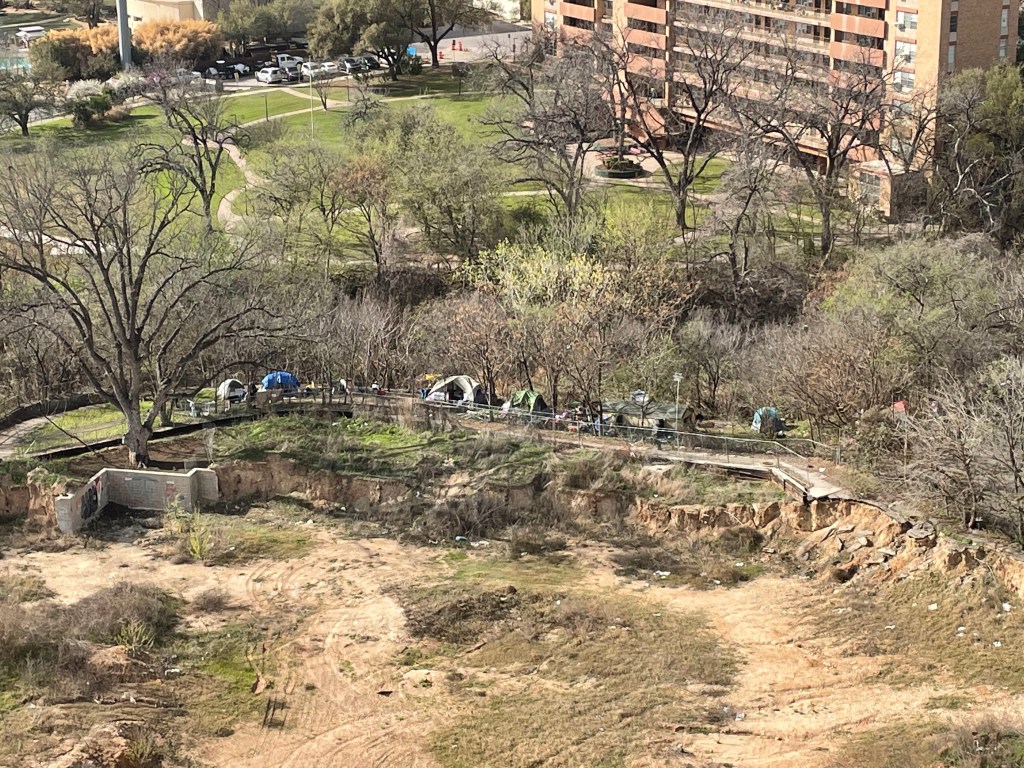
Anyone who has been almost anywhere in Austin in the past 2 years knows that the current ordinance, which only prohibits camping on sidewalks and in public parks and greenbelts, has led to homeless camps popping up everywhere.  There are plenty of stories about the impact that this has had on people from Austin, or just visiting Austin, trying to enjoy our great city (see stories at https://www.saveaustinnowpac.com/hear-from-austinites).  Most of us who live in downtown Austin no longer feel safe walking near our own homes, even in the daytime.

Part of the problem with the current ordinance is the attitude of the Austin City Council and homeless advocacy groups who oppose enforcement of any penalties for violation of the ordinance.  As a result, there are homeless camps filling the sidewalk on the south side of Cesar Chavez from Lavaca Street to Congress Avenue and spilling over into the Lady Bird Lake Greenbelt, clearly in violation of the current ordinance.  A homeless man from Corpus Christi pitched his tent in and took over the gazebo on the Butler hike and bike trail.  I have reported multiple tents and encampments at the Mexican American Cultural Center and the Waller Creek greenbelt, and there has been no response.  

Now that Proposition B is on the ballot, virtually the entire City Council, led by Ann Kitchen, has said that they would vote not to enforce the ordinance if it passes.  But that is mostly why we have the problem in the first place.  

In the period of about 5 years, with a City Council that has been unwilling and unable to solve the homeless problem, the downtown area has become a trash pit, drug den, and a focus for criminal behavior.  Anyone who does not believe that the homeless population is significantly responsible for the deterioration in the quality of life in downtown Austin is ignoring the facts.  Look at police crime statistics (see the post Crime in Downtown Austin).   Property crimes are three times more common in downtown Austin along Interstate 35 when compared to west Austin.  Assault and other violent crimes are twice as common.  You can see other similar patterns in areas where homeless encampments are found (subscribe to SpotCrime.com to see reports for your neighborhood). 

On March 11, 2021, ATXelerator and Ward Tisdale hosted a panel discussion with Matt Mackowiak of the Save Austin Now Committee, City of Austin Mayor Pro-Tem Natasha Harper-Madison, and Ending Community Homelessness Coalition Executive Director Matt Mollica.  The exchange clearly showed how polarized views on the homeless situation could be, but it also revealed how out of touch the City Council and homeless advocates are with the reality that exists.  Ms. Harper-Madison and Mr. Mollica stated that the causes of homelessness in Austin are rising rents, wage stagnation, economic segregation and poverty, and incarceration.  This is only true for a small minority of the temporarily homeless.  For the majority of the homeless population which is chronically homeless, numerous studies and surveys confirm the causes of their situation are mental illness, substance and alcohol abuse, and a yes, a lack of affordable housing.  It is difficult to find affordable housing if you do not work and do not have an income, and it is even more difficult to find affordable housing in downtown Austin.

Mr. Mollica stood by the results of the Housing and Urban Development Point-in-Time survey done in 2019 that suggests that there are about 2500 homeless persons in Austin, and only about 1900 unsheltered.  If that is true, Austin is spending about $24,000 for each homeless person each year, and most are still living in a tent under a bridge.  Mr. Mollica also inferred that the majority of homeless persons recently became homeless in Austin.  But later he did comment that most of the homeless population seems to be chronically homeless.  It is important to understand that the Point-in-Time survey is simply a count of the homeless population with basic demographic information like age, sex and ethnicity.  It is required for cities to be eligible for federal funds to manage homelessness.  It is not designed to identify causes of homelessness, length of homelessness, trends in migration, or even the need for specific services.  Most surveys of homeless populations are done in populations visiting shelters.  These individuals are more likely to be local, temporarily displaced, female gender, or families.  These are not the people that I encounter every day downtown.  There are very few scientific surveys of the chronically homeless and unsheltered population.  One of the best studies in this regard was done in Manhattan in 2009.  I would argue as Ms. Harper-Madison and Mr. Mollica did that Austin is now a large metropolitan city and our homeless population is probably similar to that of Manhattan.  In that survey, 67% were chronically homeless and unsheltered, and that group was 90% male, about 47 years of age, and had spent almost 10 years on the streets on average.  84% had a history of lifetime mental illness, lifetime substance abuse, or a serious medical issue, and 76% had been incarcerated.  (see the full text publication here https://ps.psychiatryonline.org/doi/10.1176/ps.2009.60.7.978?url_ver=Z39.88-2003&rfr_id=ori:rid:crossref.org&rfr_dat=cr_pub%20%200pubmed).  

At one point in the discussion, Mr. Tisdale read a comment from a viewer on the webcast who said that they no longer felt safe walking on the hike and bike trail or on the downtown streets.  Ms. Harper-Madison responded, “We are a rapidly growing [city], the eleventh largest now, but headed to being the tenth largest, and we still treat this city like it is 1985.  We have to come to terms with the fact that we are a rapidly growing city and major metropolitan.  There are folks that are experiencing great prosperity, but they are not prepared to handle some of the other outcomes when the city grows.”  Do I need to explain what is wrong with this attitude, especially from someone who is supposed to be managing city growth and development, and at the same time keeping us safe?

The City Council and Ms. Harper-Madison argue that a legal case Martin vs. Boise does not allow cities to enforce ordinances against camping, loitering or panhandling.  This is not true.  In this case, the US Supreme Court let stand a lower court decision that the city of Boise, Idaho could not make it illegal to sleep or camp in a public place if there were no options for shelter available.  This ruling does not prohibit reasonable restrictions on where sleeping (loitering) and camping may be allowed.  The current ordinance in Austin reflects this.  In addition, there is plenty of crime and safety data to support prohibiting camping in downtown Austin and in the University of Texas area. 

Ms. Harper-Madison and Mr. Mollica also argued that the proposed ordinance will not end the homeless problem in Austin.  This is true.  Neither will non-enforcement of the current ordinance and the expenditure of about $60 million a year on tents, sleeping bags and bicycles.  As to the majority of the homeless population who are chronically homeless and will require permanent housing, this should be up to the state and federal government, and not left up to cities.  Otherwise, you will have smaller cities without sufficient resources pushing their homeless population to Austin – which is already happening.  (See the article Homelessness in Downtown Austin

For now, vote YES on Proposition B on May 1.  Then demand enforcement of the ordinance.

What to do in a pandemic – what I got right and what I got wrong

Updated 3.10.2021

Photo by Anna Shvets on Pexels.com

One of my first posts was What to do in a pandemic? At the time I posted in October, we were about 7 months into the Covid-19 pandemic, and things were a mess. I got most things right, and we have some clarity about some other things. I also got some things wrong. So here are the clarifications and corrections. I will leave the original blog post here so you can read it if you like.

I was right in general about the characteristics of the virus and risk of infection and death. These are things that science had already confirmed. We know now that mortality due to Covid-19 is 10 times higher than for influenza, and the hospitalization rate is also 10 times higher. I was right about the risk of travel. Community surveillance has shown that travel, including staying in a hotel is high risk. We also know that new variants of the virus have been spread around the world and around the country because of travel. Community surveillance has also shown that getting together in groups spreads infection, regardless of hygiene and social distancing in those groups. Some of it is because you cannot really practice social distancing in a group. There are too many chances to break the rules. In terms of rates of transmission, Covid-19 is again not like the flu. One person with the flu may result in transmission to about 50 other people over two months through community spread. One case of Covid-19 is likely to result in the infection of more that 2000 people through community contact. In addition, you have the problem of asymptomatic spreaders, who don’t know that they should not even be with a group. That is a result of the longer asymptomatic incubation period of Covid-19. As a result, you have higher rates of infection associated with visiting a restaurant or a grocery store, even if you try to follow hygiene and social distancing recommendations.

Because of surges after the holiday periods, we were able to confirm that the number of cases would begin to rise about 10 days after an event, and then because of continuous community spread, surges last for about 2 months.

Community surveillance has confirmed the benefit of wearing masks. This is no longer just a theory. It appears that wearing a mask may not only keep you from spreading an infection, but may also protect you from infection – especially if you double mask. So, there is no excuse for not wearing a mask in public.

I believe that I was right about keeping schools closed. Knowing what we know about Covid-19, there is no reason to put anyone at risk in a group setting for up to 8 hours (remember that we know that spread occurs in groups even if they are practicing hygiene and social distancing). We do not need to risk 2000 additional infections because one child went to school with no symptoms. Again, the focus and the money should be in getting kids back to their grade level once this pandemic is over.

I also believe that I was right about unnecessary testing. We spent a lot of money on community testing that accomplished nothing positive. It did have negative effects. A negative test gave individuals a false sense of security, when the test may have been a false negative. They may then have gathered in groups or traveled spreading the infection. There were also some who used the rate of positive tests as a marker of the rate of spread in the community. This marker is completely unreliable when you do not know the characteristics of the people being tested, or that the group tested on one day was in any way similar to the group tested on a different day. The positive test rate should certainly not be used to guide public health recommendations.

Happily, what I really got wrong was the timing and speed of Covid-19 immunization. I commented before that the Food and Drug Administration had been doing a tremendous job approving new drugs during the pandemic. This is probably because the FDA is full of scientific-minded, obsessive-compulsive perfectionists. They are clearly immune to political persuasion. I was surprised at the speed by which the FDA granted emergency use authorization for the Covid-19 vaccines. I was also surprised that the FDA approved the use in the entire adult population, not just those at high risk. This is not something that scientific-minded, obsessive-compulsive perfectionists usually do. There was a risk of unproven safety with these new vaccines. But I would agree that the safety risk was overcome by the seriousness of the pandemic.

Finally, vaccine manufacturers really came through by committing resources to vaccine production. And finally, the Biden administration has helped by actually creating and executing a plan for vaccine distribution. I think that the vaccine manufacturers could have probably done this on their own, but we are finally on track in any case.

We are not done yet. We need to keep restrictions in place until all high risk individuals are vaccinated, and until the community transmission rate allows for effective contact tracing. Be respectful of others and wear a mask. Read Pandemic Update 3.

Biopharmaceutical Manufacturer Research and Development – Is this why we pay so much for prescription drugs?

Photo by RF._.studio on Pexels.com

The biopharmaceutical industry spends about $150 billion dollars on research and development every year, more than 15% of their annual revenue.  Only a few high-tech companies put more money into research and development than the biopharmaceutical industry.  This investment has resulted in an impressive number of new drugs approved in the last 10 years, including 53 approved in 2020.

Pharmaceutical manufacturers point to the high cost of research and development as one of the main drivers of prescription drug costs.  When you look at the total cost of research and development over 10 years and you divide that by the number of products approved in 10 years, it probably costs about $5 billion dollars to bring one product to the market.  That is because only about 1 in 20 molecules investigated makes it all the way from basic science to FDA approval.  And human clinical trials have become increasingly expensive, even with the FDA fast-tracking some approvals.

But is biopharmaceutical research and development providing a good value?  The cost of branded prescription drugs has risen dramatically in the last 10 years, driven by the cost of specialty drugs (see the article:  Primer on Prescription Drug Costs).  Research and development is increasingly directed to the development of specialty drugs, which include high-cost biologics.  To be sure, there have been some significant breakthroughs in the treatment of rare and previously untreatable conditions.  But with specialty drugs averaging about $100,000 a year, how many more can the healthcare system afford?  

A more basic question is why does biopharmaceutical research and development cost so much?  If we are going to accept the argument that pharmaceutical manufacturers have to price their drugs so that they can fund R&D, then we should consider why biopharmaceutical R&D is so expensive.   Certainly, human clinical trials have become more expensive due to drug costs and the cost of increasingly complex clinical protocols.  But if the human clinical development phase costs $200 – $400 million for a new drug, and the total R&D cost to bring a drug to the market is $5 billion, the clinical development phase is not where most of the money is spent.  So where is the money going?

As noted above, only about 1 out of every 20 molecules studied makes it to the market through FDA approval.  So, a lot of research and development money is spent on molecules that are abandoned in different phases of research, from basic science to clinical studies.  If the big biopharmaceutical companies that bring most drugs to the market did their own preclinical research, this could explain the high cost of basic science work.  But guess what?  Big biopharmaceutical companies are no longer responsible for the majority of new drug innovation.  In most cases, they are not even investigating the targets for new drug development.  Of the $150 billion spent on research and development each year by the biopharmaceutical industry, only about 10% is spent on preclinical studies.   Still wondering where the money is going?

For about 25 years, large biopharmaceutical companies have spent less and less identifying new molecules and instead have focused on clinical studies of existing molecules.  Today well over 60% of the new molecules in clinical phases of development are identified through research at academic institutions or small biopharmaceutical companies.   In fact, if you remove new molecules that are simply derivatives of old molecules from the calculation, almost 80% of true new molecular entities are found by academic institutions and small biopharmaceutical companies.  

Academic institutions with government or institutional funding have always contributed a lot of the basic science research relating to drug targets and molecular development.  In the past, academic scientists were commonly recruited to biopharmaceutical companies to turn their science into new medicines.  Recognizing the brain drain, academic institutions have learned how to sell their knowledge, and sometimes molecules ready for development, to biopharmaceutical companies.  Then the academic researchers can remain at their institution and move on to their next project with new funding.  In many cases, academic institutions have developed partnership agreements with biopharmaceutical companies which help ensure a new product pipeline for the collaborative partner.  In other cases, academic institutions have learned how to increase funding by selling their work (new molecules or new technology) to more than one biopharmaceutical company.   This has resulted in multiple molecules developed for the same target, diluting the value of approved drugs in a competitive marketplace.  

Independent biopharmaceutical startups are more likely to be biotech companies, focusing more on the development of technologies used in drug discovery and development.  Some academic institutions have even spun off biotechnology companies.  In recent years, a lot of research talent that used to be at the large biopharmaceutical companies has jumped to startup biotech companies.  In some cases, the biopharmaceutical companies have joint ventures with startup biotech companies, again ensuring a drug development pipeline.  But in most cases small biopharmaceutical companies are simply hoping to develop a new drug or technology, and then sell the asset or the whole company to big pharma.

There is nothing wrong with a model where academic institutions and biotech startups do most drug discovery, and then pass the molecules on to biopharmaceutical companies to complete the clinical research phases, manufacturing and marketing.  Or is there?  The problem is that all of the biopharmaceutical manufacturers seem to have the same strategy, and are competing for these molecules in the research and development market.  In most cases, they are overpaying significantly to acquire these molecules.  It does not help that startup biotechs (and even some academic institutions) are guided by venture capital sponsors.  Venture capitalists generally know how to get the most return on their investment.  The price paid commonly assumes that the new drug will make a return on investment after FDA approval.  Then once they acquire these molecules, biopharmaceutical companies are so heavily invested that they resist making the decision to end development even when a drug is not meeting clinical expectations.  More than half of drugs still fail in the clinical stages of development, whether acquired or developed in-house.  And remember the increasingly high cost of human clinical research?

In the end, it is true that research and development costs are a driver of increasing prescription drug costs.  But I would argue that the industry is wasting a lot of money on the acquisition of prospect molecules and technology.  Then they have to price approved drugs high enough to recover these asset acquisition costs.  In any case, as long as biopharmaceutical companies can name their price for new drugs, they will have little incentive to be more efficient with research and development.   

Take a look at the article: A Proposal to Control Prescription Drug Costs. 

Pandemic update 3: What do we do the next time?

Rainey Street 3.2021 – What pandemic?

We are in the third month of vaccine administration for the Covid-19 pandemic, and everyone continues to scramble for their spot in the vaccination queue.  Texas ranks 48th among the states in the per capita vaccination statistic, despite receiving lots of vaccine.  I am over 65, and can’t find anyplace to get a vaccination anywhere nearby.  I know some friends who drove hundreds of miles to get their shots.  I am not interested in doing that twice.  So, I wait and watch.   

The governor of Texas seems to think the pandemic is over.  I believe he is wrong, and is again making political decisions that put health and lives in danger (see previous posts on this topic).  In my opinion, I do not think that we should lift restrictions until the high-risk populations have been vaccinated, AND until community transmission is at a level that we can resume contact tracing and isolation.  Remember contact tracing – it is still a thing.  Travel should be limited, bars should be closed, and restaurants and other retail establishments should continue capacity restrictions.  I predict that we will have yet another surge in Texas, and that will prolong the pandemic.  And as a result, many of us will remain isolated in our homes to stay safe.  Not to mention lives will be lost.

President Biden is not helping either.  In the push to get all children back in school, now all of the teachers, administrators and school staff will be pushed into the vaccination lines with high-risk individuals.  If schools are such low risk, why do we need to do this?  And with less than three months in the school year, what will we be accomplishing?  It will take two months to get school personnel fully vaccinated.  In my opinion, in-person learning should be suspended until the end of May, when all adults in the US should be vaccinated.  Then school should start in June and run through the summer – assuming the pandemic is under control.  The objective for grade school students should be getting them back on track to graduate on time, not just getting them back in class.

But let’s assume we get the pandemic under control by mid-summer.  What do we do better when the next pandemic comes? And it will.

By definition, a pandemic is disease that is spreading throughout a large population, usually globally.  So, the first thing we need is better international vigilance and surveillance to detect potential pandemics sooner.  We can only hope that our federal government can make this happen through organizations like the World Health Organization.  The World Health Organization needs to be able to detect and classify the severity of a pandemic outbreak early (there is a Pandemic Severity Index).  Once a pandemic is determined to have high transmissibility and clinical severity, with potential global impact, international travel should immediately shut down.  This will help to prevent global spread of highly contagious diseases that result in high morbidity and mortality.  If such an outbreak is detected within the United States, interstate travel should be suspended.  This means the halt of all forms of mass transit.  

The key to controlling a pandemic is preventing uncontrolled spread of disease in communities.  When disease is detected in a community, infection control procedures should be put in place at the community level.  This starts with contact tracing which then guides isolation and quarantine restrictions.  In the case of respiratory pathogens like Covid-19, mask wearing and personal hygiene should be implemented.  Public places should institute regular disinfection protocols.  There may need to be other public health restrictions depending on the type of transmission – think Ebola.

If community transmission reaches a point where contact tracing and isolation fails to control spread, economic shutdown should come early at the community level.  You do not need to shut down the economy in Nebraska for a pandemic that is out of control in Texas, assuming that you are restricting interstate travel.  Shutdown should continue until the rate of community transmission is within the numbers where contact tracing can again become effective.  The Department of Health and Human Services of the federal government should define non-essential businesses and activities that should close during an economic shutdown.  This cannot be left up to local politicians.

Which brings us to the point of keeping politics out of decision-making during a pandemic.  In Texas, and most other states, the governor has exclusive and broad authority to manage disasters under the state emergency management statute.  It is probably not a good idea to give a single politician this level of authority in any emergency, but particularly during a public health emergency.   It is obvious that career politicians will make decisions that are political, and not necessarily in the public interest.  The emergency management statute should give the authority for managing public health emergencies to the public health authorities at the state and local level.  Public health officials should be advised by health care experts who are not elected to their positions as advisors.  These officials should have the authority to enforce restrictions and actions at the community level, where they are needed.  Again, if you can keep a pandemic under control within communities, you may not need state and national restrictions.

Finally, if you do have to shut down travel and economic activity, there needs to be a plan for supporting the economy.  The federal government needs to find a better way to do this, rather than just sending 90% of the population a stimulus check. 

Project Connect. Where are we going?

Photo by Andrea Piacquadio on Pexels.com

I originally wrote this post in February 2021, just a few months after voters approved a 22% property tax increase to pay for Project Connect. Later in 2021 news outlets reported that the projected price of Project Connect had increased from $7.1 billion to over $10 billion. Then last month, August 2022, officials from CapMetro and the Austin Transit Partnership, who are co-managing Project Connect, said cost for just the light rail components of the plan have increased 77%, from $5.8 billion to $10.3 billion. And completion of the Orange Line from north to south Austin may now require a tunnel under Lady Bird Lake which will cost an additional $1.3 billion. So if you are doing the math, the cost of Project Connect is already 82% over-budget, and the only thing that has started are improvements to the east Austin MetroRapid bus lines, that were planned before Project Connect was approved.

So what are we supposed to be getting? Project Connect consists of the creation of a Blue light rail line from the airport to west of downtown, a Gold light rail line from downtown to the capitol complex and the UT campus, the Orange light rail line on the west side from north to south Austin, and tunnels under downtown Austin connecting everything.

The Blue Line is a supposed to be a HIGH-CAPACITY light rail line that is primarily designed to connect Austin Bergstrom International Airport to downtown, and then will extend through the west Austin area, along Guadalupe to North Lamar.  The Orange Line would run along this same west Austin corridor north and south, and then continue south from downtown along South Congress to south Austin.  The Orange line converts most of the existing MetroRapid bus line 801 to light rail.  The Blue Line would also connect with a new Gold line in downtown Austin at Trinity Street, allowing travel on to the State Capitol, Dell Medical School and the East University Campus (and DKR Memorial stadium).

An unknown for all of these light rail lines, including the Blue Line, is what infrastructure has to be built and how much will it cost?  While the routes have been outlined in the Austin Strategic Mobility Plan, it has not been decided if they would be an expansion of existing right-of-way, elevated transitways, or perhaps even run in current traffic lanes.  We don’t know how the Blue Line will get across Lady Bird Lake.  So, no one really knows what the actual cost will be.  That is a big deal, but I think even more important are ridership projections and operating revenue.   Should we take a lesson about proposed ridership and operating revenues from MetroRail which was described in an article in Forbes magazine as “perhaps America’s leading transit failure?”

I traveled for business for about 30 years, thru 5-6 airports per week.  I traveled to all the major cities in the US, including those in the northeast, where there is a lot of mass transit.  I tried traveling to downtown Philadelphia from the Philadelphia International Airport once, and never did it again.  The trip took me two hours total, and would have been 20 minutes by taxi.  I also tried traveling from the O’Hare Airport Hyatt to downtown Chicago on the “L” once, and only once.  That trip took 2 ½ hours, and would have been 25 minutes by taxi (now the trip by taxi takes 40 minutes, but still much faster).   

The Blue Line is supposed to run from ABIA every 10 minutes.  But frequency of departures is not the problem.  I count 8 stops on the way to Trinity Street downtown.  Most of these stops are in east Austin along Riverside Drive.  I cannot imagine much travel from these neighborhoods to downtown or the airport.  But the train will stop for a handful of people.  I predict the ride will take about 40 minutes, and there will be an average of another 20 minutes walking or otherwise catching a ride to your final destination in the downtown area.  That is a one-hour trip, which currently takes 20 minutes by ride-share or taxi.  

Proponents will argue that traveling by the train will be cheaper.  Most people traveling from ABIA into Austin will be on an expense account like I was.  Or the difference in cost will be meaningless to them (all those people who come to the Formula 1 races, and our politicians).  Or they will be traveling in a group, in which case sharing a ride-share will be cheaper than train tickets.  I will also have to tell you that I live downtown and traveled to the airport regularly, and I rarely even used ride-share.  It was easier just to get in my car, drive 15 minutes to off-airport parking, let them take 10 minutes busing me to the airport, and I was still generally through security in 30 minutes.  I expensed the parking.

The proposed underground tunnels would go from approximately the Travis County Courthouse on Lavaca Street, south to about 4th Street, and then east to Trinity Street and then north to about 11th Street (access to the State Capitol and office complex).   There is a stop on the west side at Republic Square and at the Trinity Street MetroRail station on the east side.  Otherwise, it looks like an underground walk from Lavaca Street to Trinity Street.  There will be shops and restaurants in the tunnel for your enjoyment.  But do we need the expense of an underground tunnel to make room for more shops and restaurants than we already have above ground?

Which brings us again to the issue of unknown expense.  There has never been a tunnel project in the United States that has come in on budget.   Look at our own experience digging a short tunnel for the Mopac HOV lanes.  The original bid for the roadway was for $137 million, but ended up costing over $171 million because of the short tunnel.  The contractor found that the rock in west Austin is actually pretty hard.  They asked for an additional $100 million to dig the tunnel, and construction was delayed two years while they worked out an agreement with TX DOT.   Or look at the most recent large scale urban project, the Alaskan Way Viaduct in Seattle.  It was originally budgeted at $2 billion, ultimately cost at least $3.2 billion, and was delayed four years because the drill bit hit an underground pipeline.  

I live downtown and I could have a Blue Line stop very close to me.  But looking at the map, I cannot imagine why I would get on a light rail line.  The lines do not go anyplace that I would want to go (I do not anticipate going to a soccer game at McKalla Q2 Stadium).  Even if I wanted to avoid parking a car at the airport for a personal trip with my wife, do I really want to haul her suitcases (plural) on and off of the Blue Line?  No.  

For more information on Project Connect go here: https://communityimpact.com/austin/central-austin/transportation/2022/08/05/project-connect-planners-reviewing-hard-choices-for-light-rail-rollout-amid-rising-costs/

A proposal to control prescription drug costs

I have said that I believe that prescription drugs are the best value in healthcare.  I believe this is still the case, but the rise in the cost of prescription drugs recently has put that value proposition at risk.

In the article “A Primer on the Cost of Prescription Drugs” I laid out some of the factors driving increased cost: specialty drugs, unregulated pricing, lack of marketplace incentives for lower prices, and yes, even competition within drug classes.  Pharmaceutical manufacturers have successfully argued that regulated pricing would discourage research and development investment, which is more and more focused on specialty drugs.  This is important, because many specialty drugs are providing breakthroughs in the treatment of conditions that previously had few if any treatment options.  As a result, there are a lot of advocates supporting specialty drug research and development.  But without some regulation or marketplace influence on pricing, we will reach a point where access to important prescription drugs will be limited because of cost.  This will occur because patients can’t afford out-of-pocket costs, payers restrict access, or government programs just don’t cover.   If you think that the government programs would have to cover medically necessary drugs, you should look at the European Union models, and you should know that state Medicaid programs already don’t pay for drugs when there is no money in the budget.

There is a relatively simple solution to control prescription drug pricing trends.  It avoids government control of pricing, which can result in putting politics and cost ahead of patient benefit.  It provides an incentive for pharmaceutical manufacturers to set prices responsibly.  And it provides a potential revenue stream for the federal government.   Something for everybody.

The solution I propose is the implementation of a graduated federal excise tax on prescription pharmaceuticals based on an assessment of incremental cost-effectiveness.  A value-added tax (VAT) is an excise tax commonly used in Europe, that taxes the value of goods based on their added value (margin) at each step of the supply chain. For U.S. prescription pharmaceuticals the excise tax would be more accurately called a “value not added tax”. Let’s call it a “Price Over Value” (POV) tax.

Incremental cost-effectiveness is the comparison of the cost and health benefit of a new therapy to the cost and health benefit of a previous standard of care.  Incremental cost-effectiveness is generally calculated as an incremental cost-effectiveness ratio.  Health benefit is usually estimated using quality adjusted life years (QALYs).  There are sophisticated models that calculate QALYs.  Basically, a new therapy that has the potential to extend life for 1 year with excellent quality of life has a value of 1.  A therapy with the potential to extend life for 1 year, but with moderate side effects, might have a QALY of .75. 

There are a number of organizations that already provide incremental cost-effectiveness assessments for prescription drugs.  In the United Kingdom, the National Institute for Health and Care Excellence has used an incremental cost-effectiveness model for evaluating new drug therapies for over 20 years.  It establishes a price that the National Health Service uses to negotiate whether or not a new therapy will be covered by the National Health Service.   The Institute for Quality and Efficiency in Healthcare in Germany does the same thing, using a methodology that allows for different cost-effectiveness thresholds for different therapeutic areas.  In the US, the Institute for Clinical and Economic Review (also known by the acronym ICER) has provided reports on incremental cost-effectiveness of drug therapies since 2006.  ICER is an independently funded organization created at Harvard Medical School.  Increasing support over the years, especially from payers, has expanded their capacity to produce reports and refine their assessment models.   ICER has recently expanded their cost threshold range to accommodate the high cost of drugs for rare diseases.  Importantly, ICER also created a model assessing price increases for drugs already on the market, and issued a report “Unsupported Price Increases” in 2019.  Basically, the model argues that price increases should be supported by new evidence of clinical benefit.

Any of these incremental cost-effectiveness models can be used to assess the value of prescription drugs.   The ICER cost-effectiveness threshold ranges from $50,000 to $200,000 per QALY provide a reasonable benchmark for prescription drug value.  

How would a federal excise Price Over Value (POV) tax work to incentivize responsible drug pricing by pharmaceutical manufacturers?  The POV tax would differ from a value-added tax in that pharmaceutical manufacturers would pay a tax on the drug’s full Actual Sales Price (ASP).  As an example, the POV tax could graduate from 10% to 15% and finally 25% based on how much the drug price exceeds the calculated cost-effectiveness threshold.  Here is how it might work:

  • A drug that exceeds the cost-effectiveness threshold by 25% is assessed a POV tax of 10% paid by the manufacturer on the actual sales price.
  • A drug that exceeds the cost-effectiveness threshold by 50% is assessed a POV tax of 15% paid by the manufacturer on the actual sales price.
  • A drug that exceeds the cost-effectiveness threshold by 100% is assessed a POV tax of 25% paid by the manufacturer on the actual sales price.
  • Any drug exceeding the cost-effectiveness threshold by 25% or more is also assessed a 10% VAT paid on net profit by the pharmacy benefit manager (PBM) or wholesale to retail distributor.  This provides an incentive for PBMs and wholesalers to use the current marketplace to put additional price pressure on pharmaceutical manufacturers.

You might wonder how many drugs might be subject to this new tax? Extrapolating from ICER data, almost 15% of prescription pharmaceuticals may currently exceed the 100% cost-effectiveness value threshold.

What are the effects of implementing a pharmaceutical Price Over Value tax?  The systematic development of an incremental cost-effectiveness value will provide pharmaceutical manufacturers with a target for responsible pricing.  The tax and resulting reduction in life-cycle income for a product in development will make pharmaceutical manufacturers reconsider development of drugs with marginal clinical benefit, especially new drugs in competitive classes.  This POV tax model can eventually be applied to the price increases of drugs already in the marketplace.  If price increases for a marketed drug result in costs exceeding the incremental value threshold, the POV tax can be applied.  Incremental value thresholds can be adjusted based on new indications that provide increased clinical benefit.  For example, you might see the POV tax removed for cancer drugs that have limited clinical benefit initially in the advanced, metastatic disease setting, but then demonstrate more value in the treatment of early-stage cancer.   The VAT at the PBM and distributor level will provide an incentive for them to create cost-effective formularies and preferred drug lists.  Finally, implementation of the POV tax will provide a revenue stream for the federal government.  And you do all of this without government price controls and without directly restricting pharmaceutical research and development.  

What is needed to implement this proposal?  Obviously, it will take an act of Congress.  First, you have to establish the organization responsible for incremental value assessments and cost thresholds.  ICER is already doing this work, but it is an independent organization not sanctioned by the federal government.  The Patient-Centered Outcomes Research Institute established by the Affordable Care Act in 2010 would be an obvious choice to assume this role.  Second, the taxing structure must be legislated.  Third, how and when the tax is applied will have to be decided.  Value assessments for new drugs can begin as soon as the clinical benefit data are available from clinical trials.  There will need to be agreement on how new clinical data are provided to the organization providing the value assessment.   Ideally, a cost threshold would be available before the launch of a new product so that manufacturers can consider the threshold when setting prices.   Prescription drugs already marketed can also be assessed to establish value thresholds and consider price increases.  Manufacturers could use discounts and rebates to lower drug ASPs below tax assessment thresholds.

Let the arguments begin.