On May 1st, 2021 Austinites will vote on a new ordinance to roll back the ordinance that replaced the ordinance that replaced the ordinance banning camping on public property without a permit. The special election item, Proposition B, will be on the ballot as the result of a petition signed by over 26,000 Austin residents and sponsored by the Save Austin Now non-profit advocacy group. Essentially, the proposed ordinance would reinstate a ban on camping and loitering in the downtown and University of Texas areas, and in public parks and greenbelts, and would prevent panhandling in those areas from 7 PM to 7 AM.
Anyone who has been almost anywhere in Austin in the past 2 years knows that the current ordinance, which only prohibits camping on sidewalks and in public parks and greenbelts, has led to homeless camps popping up everywhere. There are plenty of stories about the impact that this has had on people from Austin, or just visiting Austin, trying to enjoy our great city (see stories at https://www.saveaustinnowpac.com/hear-from-austinites). Most of us who live in downtown Austin no longer feel safe walking near our own homes, even in the daytime.
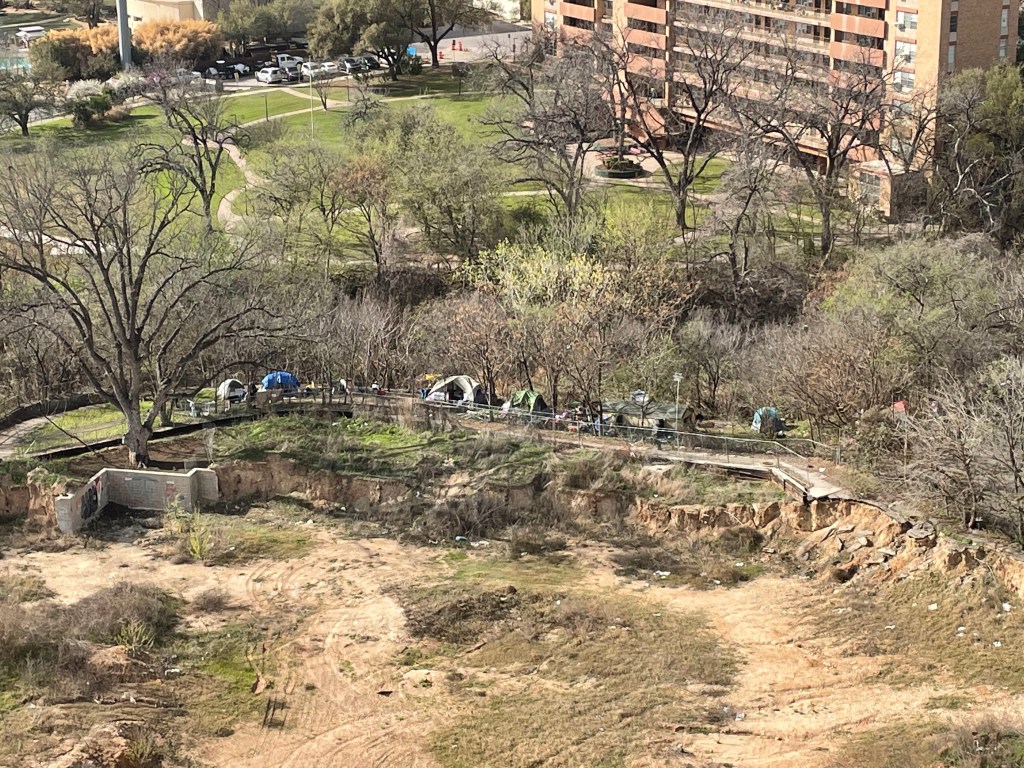
Part of the problem with the current ordinance is the attitude of the Austin City Council and homeless advocacy groups who oppose enforcement of any penalties for violation of the ordinance. As a result, there are homeless camps filling the sidewalk on the south side of Cesar Chavez from Lavaca Street to Congress Avenue and spilling over into the Lady Bird Lake Greenbelt, clearly in violation of the current ordinance. A homeless man from Corpus Christi pitched his tent in and took over the gazebo on the Butler hike and bike trail. I have reported multiple tents and encampments at the Mexican American Cultural Center and the Waller Creek greenbelt, and there has been no response.
Now that Proposition B is on the ballot, virtually the entire City Council, led by Ann Kitchen, has said that they would vote not to enforce the ordinance if it passes. But that is mostly why we have the problem in the first place.
In the period of about 5 years, with a City Council that has been unwilling and unable to solve the homeless problem, the downtown area has become a trash pit, drug den, and a focus for criminal behavior. Anyone who does not believe that the homeless population is significantly responsible for the deterioration in the quality of life in downtown Austin is ignoring the facts. Look at police crime statistics (see the post Crime in Downtown Austin). Property crimes are three times more common in downtown Austin along Interstate 35 when compared to west Austin. Assault and other violent crimes are twice as common. You can see other similar patterns in areas where homeless encampments are found (subscribe to SpotCrime.com to see reports for your neighborhood).
On March 11, 2021, ATXelerator and Ward Tisdale hosted a panel discussion with Matt Mackowiak of the Save Austin Now Committee, City of Austin Mayor Pro-Tem Natasha Harper-Madison, and Ending Community Homelessness Coalition Executive Director Matt Mollica. The exchange clearly showed how polarized views on the homeless situation could be, but it also revealed how out of touch the City Council and homeless advocates are with the reality that exists. Ms. Harper-Madison and Mr. Mollica stated that the causes of homelessness in Austin are rising rents, wage stagnation, economic segregation and poverty, and incarceration. This is only true for a small minority of the temporarily homeless. For the majority of the homeless population which is chronically homeless, numerous studies and surveys confirm the causes of their situation are mental illness, substance and alcohol abuse, and a yes, a lack of affordable housing. It is difficult to find affordable housing if you do not work and do not have an income, and it is even more difficult to find affordable housing in downtown Austin.
Mr. Mollica stood by the results of the Housing and Urban Development Point-in-Time survey done in 2019 that suggests that there are about 2500 homeless persons in Austin, and only about 1900 unsheltered. If that is true, Austin is spending about $24,000 for each homeless person each year, and most are still living in a tent under a bridge. Mr. Mollica also inferred that the majority of homeless persons recently became homeless in Austin. But later he did comment that most of the homeless population seems to be chronically homeless. It is important to understand that the Point-in-Time survey is simply a count of the homeless population with basic demographic information like age, sex and ethnicity. It is required for cities to be eligible for federal funds to manage homelessness. It is not designed to identify causes of homelessness, length of homelessness, trends in migration, or even the need for specific services. Most surveys of homeless populations are done in populations visiting shelters. These individuals are more likely to be local, temporarily displaced, female gender, or families. These are not the people that I encounter every day downtown. There are very few scientific surveys of the chronically homeless and unsheltered population. One of the best studies in this regard was done in Manhattan in 2009. I would argue as Ms. Harper-Madison and Mr. Mollica did that Austin is now a large metropolitan city and our homeless population is probably similar to that of Manhattan. In that survey, 67% were chronically homeless and unsheltered, and that group was 90% male, about 47 years of age, and had spent almost 10 years on the streets on average. 84% had a history of lifetime mental illness, lifetime substance abuse, or a serious medical issue, and 76% had been incarcerated. (see the full text publication here https://ps.psychiatryonline.org/doi/10.1176/ps.2009.60.7.978?url_ver=Z39.88-2003&rfr_id=ori:rid:crossref.org&rfr_dat=cr_pub%20%200pubmed).
At one point in the discussion, Mr. Tisdale read a comment from a viewer on the webcast who said that they no longer felt safe walking on the hike and bike trail or on the downtown streets. Ms. Harper-Madison responded, “We are a rapidly growing [city], the eleventh largest now, but headed to being the tenth largest, and we still treat this city like it is 1985. We have to come to terms with the fact that we are a rapidly growing city and major metropolitan. There are folks that are experiencing great prosperity, but they are not prepared to handle some of the other outcomes when the city grows.” Do I need to explain what is wrong with this attitude, especially from someone who is supposed to be managing city growth and development, and at the same time keeping us safe?
The City Council and Ms. Harper-Madison argue that a legal case Martin vs. Boise does not allow cities to enforce ordinances against camping, loitering or panhandling. This is not true. In this case, the US Supreme Court let stand a lower court decision that the city of Boise, Idaho could not make it illegal to sleep or camp in a public place if there were no options for shelter available. This ruling does not prohibit reasonable restrictions on where sleeping (loitering) and camping may be allowed. The current ordinance in Austin reflects this. In addition, there is plenty of crime and safety data to support prohibiting camping in downtown Austin and in the University of Texas area.
Ms. Harper-Madison and Mr. Mollica also argued that the proposed ordinance will not end the homeless problem in Austin. This is true. Neither will non-enforcement of the current ordinance and the expenditure of about $60 million a year on tents, sleeping bags and bicycles. As to the majority of the homeless population who are chronically homeless and will require permanent housing, this should be up to the state and federal government, and not left up to cities. Otherwise, you will have smaller cities without sufficient resources pushing their homeless population to Austin – which is already happening. (See the article Homelessness in Downtown Austin)
For now, vote YES on Proposition B on May 1. Then demand enforcement of the ordinance.
 Waterloo to Austin