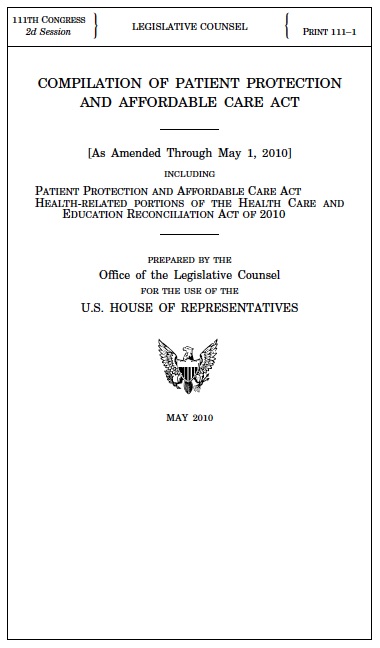
The short answer is yes – while imperfect, the Affordable Care Act has done what it was intended to do – provide healthcare insurance coverage to millions of people. And if there was something better, it would have been proposed by someone by now.
On November 10, 2020 the Supreme Court heard arguments from the solicitors representing numerous republican state attorneys general who have sued to have the ACA overturned. This all originally started in 2018 with the argument that the ACA was unconstitutional because of the individual mandate to buy insurance, including penalties for individuals who did not buy insurance and for employers who did not offer insurance to employees.
The position of the federal government (the Trump administration) was originally that the entire Act was invalid, but in recent filings they have recommended that only provisions injuring the individual plaintiffs (states and a couple of individual persons in the suit) should be removed. Even this is unusual, as the federal government usually tries to protect federal law. Despite all of the rhetoric to the contrary, the federal government’s latest position calls for invalidation of coverage for pre-existing conditions, guaranteed issue and community rating, along with the individual mandate. Congress removed the financial penalty enforcing the individual mandate in 2019.
Will the Supreme Court strike down the entire ACA? The short answer is no. As with most major legislation, the ACA is cluttered with all kinds of amendments to the federal statutes, and many of them generate significant income for the US Treasury. Here are some of the things included in the Affordable Care Act:
- Coverage for pre-existing conditions, coverage for dependent children to age 26, elimination of annual and lifetime coverage limits, mandated benefits, zero-dollar coverage for preventive services.
- State and federal exchanges for individual insurance based on community rating, not individual health status.
- Expansion of Medicaid eligibility with initial federal funding at 100% if accepted by the states.
- Excise taxes on pharmaceutical manufacturers (excise taxes on device manufacturers and health insurance companies were repealed in 2019).
- Rebates required from pharmaceutical manufacturers and insurance companies to reduce out of pocket expenses for Medicare Part D prescription drugs (worth about $8 billion/year).
- Increased pharmaceutical manufacturer rebates to the Medicaid program (worth about $2.8 billion/year).
- Expansion of the 340B rebate program requiring rebates from pharmaceutical manufacturers to an expanded list of hospitals, including rural hospitals, trauma centers and cancer centers (probably worth at least $10 billion/year).
- Numerous pilot programs shifting Medicare payment from fee-for-service to value-based reimbursement, including Patient Centered Medical Homes, Shared Savings and Accountable Care Organization models. Proposed to be saving billions of dollars per year, and Medicare expenses have definitely slowed.
- Established the Center for Medicare and Medicaid Innovation to oversee healthcare delivery reform and quality improvement.
- ACA includes the Biosimilars Price Competition and Innovation Act, which provided the roadmap for the Food and Drug Administration to approve biosimilar products, which it has done since 2015. Projected savings to the healthcare system are about $54 billion over 10 years beginning in 2017.
- Regulations too numerous to count were enabled by the ACA.
If the ACA were completely overturned, the pharmaceutical industry and others might have a pretty good argument that they should recapture billions of dollars that they have paid or not been paid under provisions of the Act since 2011. And a lot of regulations would no longer have enabling legislation.
So, what do you do with the Affordable Care Act? Let’s start with Medicare for All. Medicare historically has been a mess, with limited benefits, arcane reimbursement systems, and before 2006, no prescription drug benefit. It was so bad that many employers offered commercial retirement plans before 2006. From the provider side, fee-for-service Medicare reimbursement is so low that in many places it is difficult to find a primary care provider who will accept new Medicare patients. Medicare has been saved by the Part C program, which allows private insurance programs to administer Medicare program benefits. Benefits have improved (including preventive health services) and costs have come down. But Medicare is not an example of a program that should be expanded to cover everyone.
What about Medicaid expansion? Medicaid is funded by the federal and state governments and is heavily regulated. As with the federal government and Medicare, the states have had to contract Medicaid administration to private insurance plans because the government programs were failing. These contracts with private insurance plans require special waivers from the federal government because of bureaucratic regulations. Reimbursement is bad, providers are few, and the quality of care is marginal. Not the program for the broader population.
Most people in the US are still covered by employer sponsored programs. While individuals complain about their health insurance companies, they like their employer sponsored benefits. These benefits are comprehensive, and employers usually pay a large part of the premium. Problem is, you only have employer sponsored coverage if you are employed. If you have ever had to pay for COBRA coverage between jobs, you have seen what the total premium cost looks like (the average 2020 premium for family coverage is over $21,000).
Prior to the Affordable Care Act, there was an individual insurance market, but these policies required underwriting, restricted coverage for pre-existing conditions, and premiums were based on individual health status. If you developed significant health problems you could be non-renewed at the end of the policy year. The Affordable Care Act created exchanges that pool people of different levels of risk together, and requires premiums to be community based and not rated to the individual. This significantly lowered the cost of individual insurance in 2014. Coverage is guaranteed and has to be renewed as long as premiums are paid. But in order for this model to be sustained, it requires some mandate to require people who are low-risk to buy into the exchanges. Otherwise, only people who need to use health services will buy insurance, and only when they need it. That is why the ACA included individual and employer mandates to obtain and provide coverage. And a mandate only works if there is a penalty.
The individual and employer mandate penalties required the payment of an income tax assessment. One of the problems with the ACA was that these penalties were not high enough. In the first few years, the individual penalty was only a few hundred dollars. Young, healthy people weighed paying a few hundred dollars in income tax, or paying up to $7000 for health insurance, and opted out. This increased the risk and costs in the exchanges, and led to premium increases for those who opted in.
When you consider the options for improving the availability of insurance to the US population, it seems like expanding all of the current programs might be preferrable to trying something completely new. And that is what the Affordable Care Act did. The problems with the ACA stem from a lack of adequate funding, and not ensuring that the individual mandate penalties would drive healthy people to participate. Some of the mandatory benefits might be reconsidered in order to make the program more cost-effective (for example, should all males and females pay for the maternity benefit?). But in general, it works.
In any case, I predict that the Affordable Care Act will survive for the most part, and it will require updating.
 Waterloo to Austin